
Nematodes in Agriculture: Identification, Damage, and Control Methods
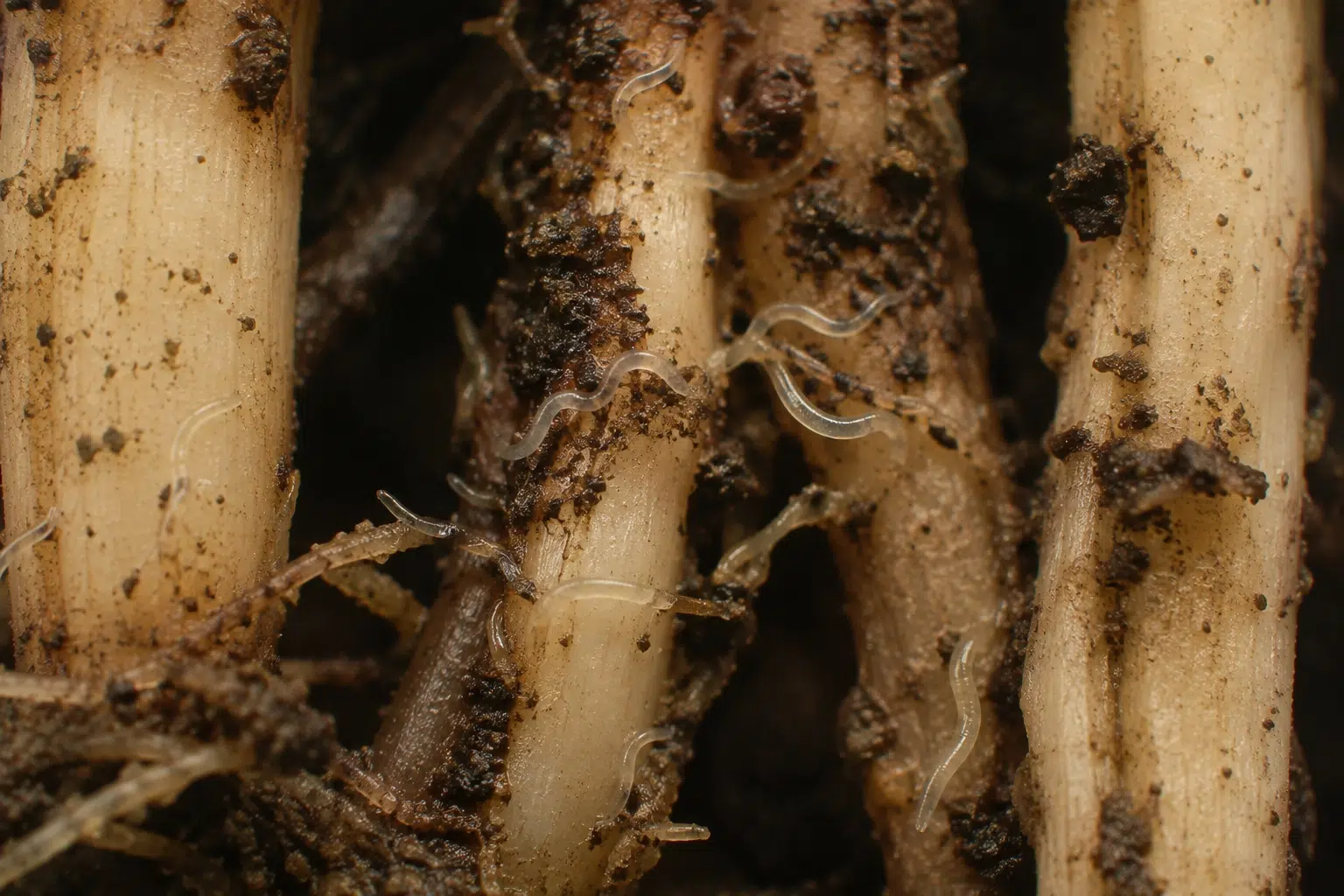
They are invisible, live beneath your feet, and can ruin an entire crop. Nematodes are tiny roundworms, also known as threadworms or eelworms. It is estimated that there are several million species, although only about 25,000 have been described to date. Most live freely in the soil or water, where they play an essential role in recycling organic matter and nutrients. But some species, known as parasitic nematodes, attack plants, animals, or even humans.
In agriculture, plant-parasitic nematodes are the problem. Invisible to the naked eye, they parasitize plant roots and can cause significant yield losses. How can we identify them, limit their spread, and—most importantly—get rid of them? That’s exactly what we’ll explore in this article.
The Most Common Nematodes
Not all nematodes pose the same level of danger. Certain species are particularly feared in agriculture because of the damage they cause to crops. Here are the main types of plant-parasitic nematodes that are most commonly encountered, along with their characteristics.
- Root-knot nematodes (Meloidogyne spp.): These are the most widespread nematodes in the world. By feeding on the roots, they cause the formation of galls (swellings) that interfere with the plant’s absorption of water and nutrients.
- Cyst nematodes (Heterodera and Globodera spp.): Among the best-known species are Heterodera schachtii, which causes beet cyst nematode, as well as Globodera rostochiensis and Globodera pallida, which infest potatoes. The females develop into highly resistant cysts capable of surviving for several years in the soil.
- Root-lesion nematodes (Pratylenchus spp.): These migratory endoparasites penetrate the roots and burrow tunnels within them, causing lesions that facilitate the entry of fungi and other pathogens.
- The crown and bulb nematode (Ditylenchus dipsaci): It attacks the stems, leaves, and bulbs, causing deformities, necrosis, and stunted plant growth.
- Free-living soil nematodes (Xiphinema, Longidorus, and Trichodorus): They feed on the surface of roots and are best known for their role as virus vectors. For example, Xiphinema index transmits grapevine short-knotted virus, a disease that is particularly damaging to vineyards.
Affected crops
The damage affects a very wide range of industries:
- Field Crops : sugar beet (cyst nematode), potato (cyst and gall nematodes), cereals (Pratylenchus), rapeseed.
- Vegetable farming : tomatoes, carrots, onions, lettuce, cabbage — highly susceptible to gall nematodes.
- Perennial Crops : grapevines (short-knotted), fruit trees, nurseries.
- Legumes : soybeans, beans, peas.
Sandy or light soils, which are well-aerated and warm up quickly, are particularly conducive to the growth of nematode populations.
Symptoms Observed
Diagnosis is difficult without a soil analysis, since the symptoms are often nonspecific and can be mistaken for a nutritional deficiency or water stress:
- On the above-ground parts: stunted plants, yellowing, wilting in the middle of the day despite adequate irrigation, uneven growth in patches within the field (patches visible from the edge of the field), and reduced yield.
- On the root system: galls or swellings (gall nematodes), short, discolored, necrotic, or damaged roots (Pratylenchus), and cysts visible to the naked eye on the roots (small white to brown spots, about the size of a pinhead).
- A general reduction in the root system, which makes the plant more susceptible to drought and other soil-borne pathogens (fungi, bacteria), with wounds caused by nematodes serving as entry points.
Need some support?
Please feel free to contact us for more information about our products.
Causes and Contributing Factors
Nematode populations can increase rapidly when conditions are favorable. The main risk factors are as follows:
- Crop rotations that are too short: Regularly growing the same species or host plants promotes the accumulation of nematodes in the soil from one year to the next.
- Soil type: Sandy, light, well-drained soils are particularly conducive to their growth, unlike clay soils, which are more compact.
- Temperature and humidity: Most species thrive in sufficiently moist soil, at temperatures ranging from 15 to 30 °C.
- Spread through human activities and the environment: Nematodes move very little on their own. They are mainly transported by soil clinging to agricultural tools and machinery, contaminated plants or bulbs, and irrigation water, but are also sometimes carried by the wind or certain animals.
- The absence of non-host or resistant crops: without proper crop rotation, nematodes always have plants on which to feed and reproduce, which accelerates their proliferation.
- Root damage: Roots that have already been damaged by cultivation practices, insects, or other diseases make it easier for certain species of nematodes to penetrate the roots and worsen infestations.
Measures to Combat [the Problem]
No single method can permanently eliminate nematodes on its own. To effectively limit their presence and the damage they cause, it is essential to combine several agronomic measures as part of an integrated pest management strategy. This approach involves combining various preventive and curative practices to reduce nematode populations while maintaining soil balance.
Resistant or Tolerant Varieties
Some commercial varieties (such as tomatoes) contain genes that confer resistance to cyst-forming orgall-forming nematodes. This is often the simplest approach to implement. However, to date, there is no potato variety that is completely resistant.
Crop rotation
Alternating with non-host or less-susceptible species breaks the life cycle. However, it is important to correctly identify the nematode species in question, since a plant that is a non-host for one species may be a host for another.
Cover Crops and Green Manure
Some species are known for their nematicidal or nematostatic properties:
- Nematocide species and varieties: Certain varieties of white mustard and forage radish have recognized properties that have been evaluated by organizations and listed in national catalogs (including French, German, and Dutch ones).
- Biofumigant cruciferous crops (white mustard, brown mustard, Abyssinian mustard, forage radish, Chinese radish, and forage rapeseed): When these crops are destroyed and plowed into the soil, they release glucosinolates that break down into volatile compounds (isothiocyanates) that have a biofumigant effect on the soil.
- Forage sorghum: Suppressive effect on certain populations of cyst and gall nematodes.
Note
Cover crops with nematicidal or biofumigant properties can also reduce the use of certain plant protection products.
- Preventive measures: cleaning agricultural equipment between fields, using certified disease-free seedlings and seeds, and destroying contaminated root residues after harvest.
Do you want to take action quickly?
Check out our line of ready-to-use nematode-resistant covers.