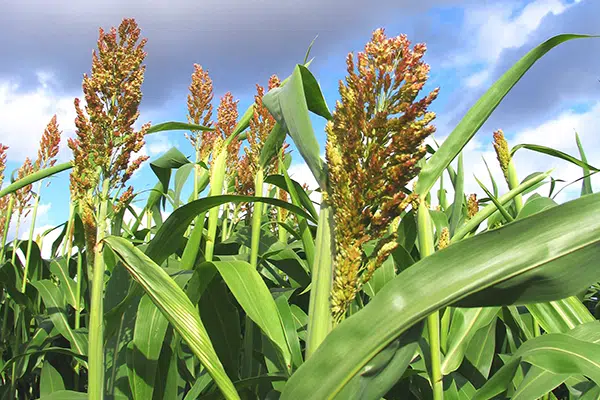
Forage Sorghum: Technical Data Sheet

Why choose forage sorghum?

Ensuring quantity and quality

  • Heat tolerance: Sorghum can grow at temperatures up to 40°C, unlike corn, which stops growing at 30°C.
  • Energy value: Sorghum derives its energy value from sugar, not starch. Once the dry matter (DM) content reaches 25%, one UFL point is achieved.

3 agronomic advantages

  • Root system: Fibrous, dense, branched, and deep (more than 1.70 m).
  • Rolling the leaves: Reduces the surface area exposed to evaporation.
  • Contains cerose: Protects against evapotranspiration.

Producing with less water

  • Water requirements: Half as much as corn (150 mm versus 275 mm).
  • Water efficiency: Better than corn (42 kg DM/ha/mm H₂O vs. 30).
  • Drought tolerance: Sorghum stops growing but remains green and resumes growth after rain.

Making Better Use of Nitrogen

  • Nitrogen removal: 240 kg N/ha for a yield of 13 t DM/ha.
  • Efficiency: 0.74 kg N/ha/mm H₂O compared to 0.33 kg N for corn.

What types of sorghum are there?

Single-cut forage sorghum

  • Harvest: All at once, after 100 to 140 days of growth.
  • Use: As silage for ruminant herds or as biomass for anaerobic digesters.

Multi-cut forage sorghum

  • Harvest: In several stages (grazing, mowing for silage/hay/green forage).
  • Categories :
    • Hybrids: High yield potential, vigorous growth habit.
    • Sudan Grass: Early maturing, high tillering and regrowth capacity, thinner stems and leaves.

What does BMR stand for?

Effect on lignin content

  • BMR (Brown Mid Rib): A brown midrib that inhibits the production of synapyl alcohol, a major component of lignin.
  • Result: Lignin content reduced by 75% compared to non-BMR sorghum.

Digestibility

  • Lignin: Reduction of 40% to 60%.
  • Digestibility: Increase from 15% to 30%.
  • UFL/UFV: Increase from 10% to 15%.
  • Ingestion: Increase of 10% to 15%.

What are the nutritional values?

Comparison of Nutritional Values

Non-BMR sorghum BMR sorghum Corn
Starch 3,60 6,60 33,60
dMO 70,5 80,8 72,7
Soluble carbohydrates 18 24,50 8
ADL 2,70 0,60 2,50
UFL 0,91 1,06 0,93
UFV 0,66 0,93 0,8
NDF 57 54 44
ADF 28,7 26,3 25,6
Cellulose 27,80 24,00 18,70
MAT 7,3 8,1 7,3
PDIE 42 67 65
PDIN 45 50 45
PDIA 16 18 16
Mineral substances 5,1 5,2 3,4
  • Stability: Nutritional value increases as the plant matures.

The Benefits of Sorghum in Cattle Rations

A burst of energy

  • Sugar content: 25–28% (glucose, sucrose, levulose).
  • UFL: 1 UFL/kg of dry matter.
  • Reduced risk of acidosis: Starch content of 2% to 8%.
  • Advantage: Does not reduce the feed's nutritional value, even with 30 to 50% sorghum.

Highly digestible fiber and cellulose

  • NDF: 52% to 57%.
  • Cellulose: 24–28%.
  • Benefits :
    • Maximizing saliva production.
    • Better regulation of rumen pH.
    • A denser fibrous lining of the rumen.
    • Better breakdown of corn kernels.
    • Reduction of bypass starch.

Increased intake

  • Digestibility: Maximized with 30% sorghum in the diet.
  • Digestive transit: Faster, with a 10–15% increase in absorption.

What are the effects on cattle?

In dairy cows

  • Milk production: On the rise thanks to improved energy efficiency.
  • Milk quality: Improved butterfat and protein content.
  • Reduced costs: Lower cell rates, lower healthcare costs, and improved fertility.

Heifers

  • Development: Improved growth; calving at age 2 is achievable.

For cull cows and finishing

  • Improved finishing: With an average daily gain of 1,940 g.

In suckler cows

  • Improved cyclicity and reproduction: Reduction of the IVV by 30 to 40 days.

Calves with their mothers

  • Growth: Weaned at 270 days and 360 kg, average daily gain of 1,150 g/day.

Young bulls

  • Growth: Average daily weight gain of 1,400 to 1,600 g, reduced mortality due to acidosis.

See also

Stay informed about the latest advances, field reports, and expert advice to optimize your yields and feed autonomy.

Have a question?
Have a request?

Contact us now, and we'll help you make the right choice without wasting any time.