
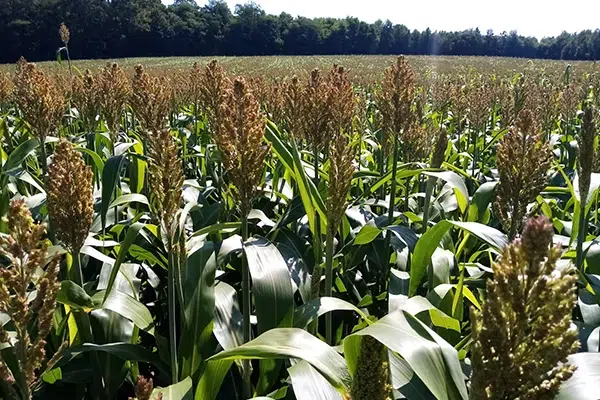
At SCEA de la Bigotterie in Maine-et-Loire, Bruno Poupart has been growing forage sorghum for over ten years without ever failing to get a good stand. For him, success depends on warm, well-prepared soil and the right seeding rate. Here are his tips, along with those from Jérémy Bonte, technical development manager at Semental, for optimizing the establishment of this crop.
Bruno Poupart stresses the importance of not sowing too early. He always waits until temperatures are high enough, usually after May 15. “You have to be in shorts to sow!” he jokes, emphasizing that it’s crucial to avoid cool nights so as not to delay germination. Jérémy Bonte confirms that it’s best to sow after the Ice Saints, that is, after May 10, to avoid the risk of frost.
The planting date is not the most critical factor, as sorghum is highly tolerant of waiting for favorable conditions. It germinates quickly as soon as it has water and warmth. However, planting after a rain is ideal for promoting uniform emergence. In very dry conditions, the risk of weed infestation is higher, as sorghum takes longer to get established than corn.
Bruno Poupart prefers “light soils”—those suitable for wheat—for growing his sorghum. These soils, composed of sand with about 10% clay, are dry and lack significant water reserves. Unlike corn, sorghum tolerates drought well and can withstand water shortages during difficult weather conditions.
Jérémy Bonte points out that there aren’t many situations where sorghum cannot be planted. You simply need to avoid clay soils and ensure that the soil is well-crumbled, tilled, and fine to ensure good contact between the seed and the soil. Careful soil preparation is essential to ensure uniform emergence.
Soil preparation is a key step in successfully planting sorghum. Bruno Poupart prepares his soil using a rotary tiller, running a rotary tiller over the field immediately after harvesting the previous crop, followed by a vibrating roller to level the soil before sowing. He emphasizes the importance of having uniform soil to promote even emergence.
Plowing helps break up the soil and promotes more even emergence. Sowing at a depth of 3 to 4 cm is recommended to reduce the risk of lodging, even though this may slightly delay emergence. No-till planting is possible, but it requires more careful management of weed control and fertilization.
To plant sorghum at the correct depth, it is not recommended to use a grain drill. Bruno Poupart uses a precision seeder equipped with specialized discs, such as those designed for sorghum or sugar beets. He plants at a density of 220,000 plants per hectare, which allows him to quickly cover the soil and minimize the risk of weed growth.
The ideal row spacing is 40 to 50 cm. Narrower row spacing promotes faster ground cover, thereby reducing weeds. For beginners, a standard spacing of 75 cm with a seeding rate of 150,000 to 170,000 seeds per hectare is recommended. Jérémy Bonte also recommends sowing at a reduced speed, around 4 km/h, to achieve more uniform emergence and a field that is easier to manage.
After sowing, Bruno Poupart weeds the crop at the two-to-three-leaf stage. He applies a post-sowing herbicide, followed by a follow-up treatment containing a root-active ingredient three weeks later. Thanks to late sowing, emergence is rapid and reduces the risk of pest attacks, such as those from wireworms.
Sorghum can also be grown without chemicals by using a harrow three or four days after sowing, followed by hoeing at the 3–4-leaf stage and, if necessary, a second hoeing at the 7–8-leaf stage. For fertilization, Jérémy Bonte recommends applying a starter fertilizer to help the sorghum get off to a quick start. The overall nitrogen requirement remains moderate, between 60 and 80 units per hectare, as over-fertilization can weaken the plant and promote lodging.
There are two main types of single-cut forage sorghum for silage: those with the BMR gene, which offer higher nutritional value but are more susceptible to lodging, and those without this gene. Bruno Poupart chose the Big-Kahuna variety, known for its high yield potential and resistance to lodging.
The cost of growing sorghum is another advantage, with estimated operating costs of €236 per hectare, compared to €330 for corn. This cost savings, combined with proper preparation and careful management, makes sorghum an attractive crop for livestock farmers looking to diversify their forage sources.
Stay informed about the latest advances, field reports, and expert advice to optimize your yields and feed autonomy.