
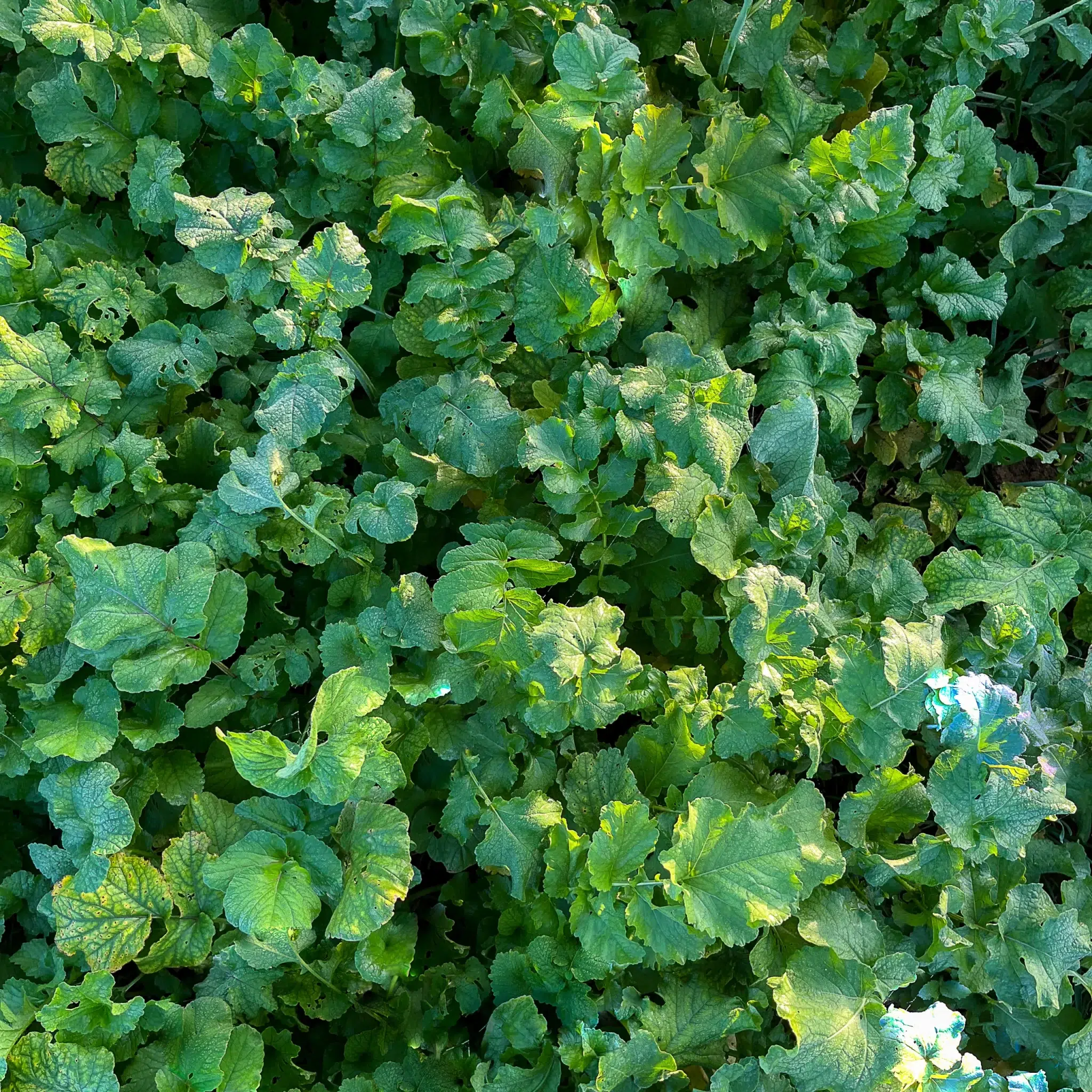
The forage radish
Why use it?
Forage radish has established itself as one of the most effective cover crops for deep soil aeration while sequestering nitrates until spring. Belonging to the Brassicaceae (or Cruciferae) family, this species is distinguished by its strong rooting ability and rapid growth.
Its TGW (Thousand-Seed Weight) of 12 grams ensures even distribution during sowing and promotes uniform emergence. For optimal establishment in pure stands, the recommended seeding rate is 9 kg/ha, ensuring balanced and high-performing ground cover. Thanks to its agronomic characteristics, this plant integrates easily into many cropping systems, whether for biomass production, improving soil structure, or enhancing the agronomic value of fields.
Uses
- Glyphosate application rates: Early growth stage: 2.5 L/ha; Mature stage: 3 L/ha
- Combination with legumes
- Do not use in crop rotations with a high proportion of rapeseed; risk of hernia
- Beet rotation: Use only nematicide-resistant varieties
- Well-suited for grain crop rotations
- Suitable for crop rotations with sorghum and corn if destroyed early
- Do not use in crop rotations with flax, beans, peas, fava beans, sunflowers, etc.
- Damage Caused by Driving Over Frozen Surfaces
- Seedlings: All types are well-suited
Are you looking for a versatile forage radish?
Mohikan is the top choice in the lineup for crop rotation to control nematodes (microscopic worms). It works equally well as a stand-alone crop or in combination with legumes or phacelia. It’s the obvious choice for a high-performing cover crop with no special requirements.
Are you dealing with a nematode infestation on your fields?
Class 1 nematicide
Rebiur
Rebiur specifically targets Heterodera schachtii, the beet cyst nematode. With plant heights of up to 70 cm and yields of 3 to 5 metric tons of dry matter per hectare, it is suitable for beet rotations under moderate pressure.
Class 2 nematicide
Toro Bio
Toro Bio goes a step further with dual action against Heterodera schachtii and Ditylenchus dipsaci (a nematode that feeds on the parenchyma of stems or bulbs). AB-certified, it offers the same agronomic performance as Mohikan with superior nematicidal efficacy for organic farms under heavy pest pressure.
Class 2 nematicide
Sixtus Bio
With the same agronomic profile as Toro Bio, Sixtus Bio offers an organic alternative to diversify your crop rotations and reduce the risk of resistance.
Still on the fence about forage radishes?
Please feel free to contact us; our advisors will help you choose the variety best suited to your crop rotation and the nematode pressure on your fields.
Benefits:
- High capacity to bind nitrates and other elements
- It retrieves nitrogen from previous years from deep underground and brings it back to the surface
Disadvantages:
- Not suitable for crop rotations with vegetables, rapeseed, or sunflowers, as it is a vector for Sclerotinia
- Does not attract pollinators
- Requires more care in its disposal than mustard
- Does not freeze until temperatures reach -10/-13°C
Which variety should you choose?
At Semental, we offer a variety of forage radish varieties suited to every situation you may encounter. Find the one that best suits your fields.
| Mohican | Rebiur | Toro Bio | Sixtus Bio | |
|---|---|---|---|---|
| For what situation? | Nematode-free crop rotation, soil restructuring | Moderate pressure on beets | Trapping beet nematodes ( ) in sugar beet cultivation, organic farming | An organic alternative for diversifying crop rotations , and trapping sugar beet nematodes |
| Yield (metric tons per hectare) | 4.5–6 | 3–5 | 4.5–6 | 4.5–6 |
| Nematicidal action | — | Class 1 H. schachtii | Class 2 H. schachtii + D. dipsaci | Class 2 H. schachtii + D. dipsaci |
| AB Certified | — | — | Organic Farming | Organic Farming |
| Frost resistance | Between -10°C and -13°C | Between -10°C and -13°C | Between -10°C and -13°C | Between -10°C and -13°C |
| Plant height | 40–60 cm | 50–70 cm | 40–60 cm | 40–60 cm |